
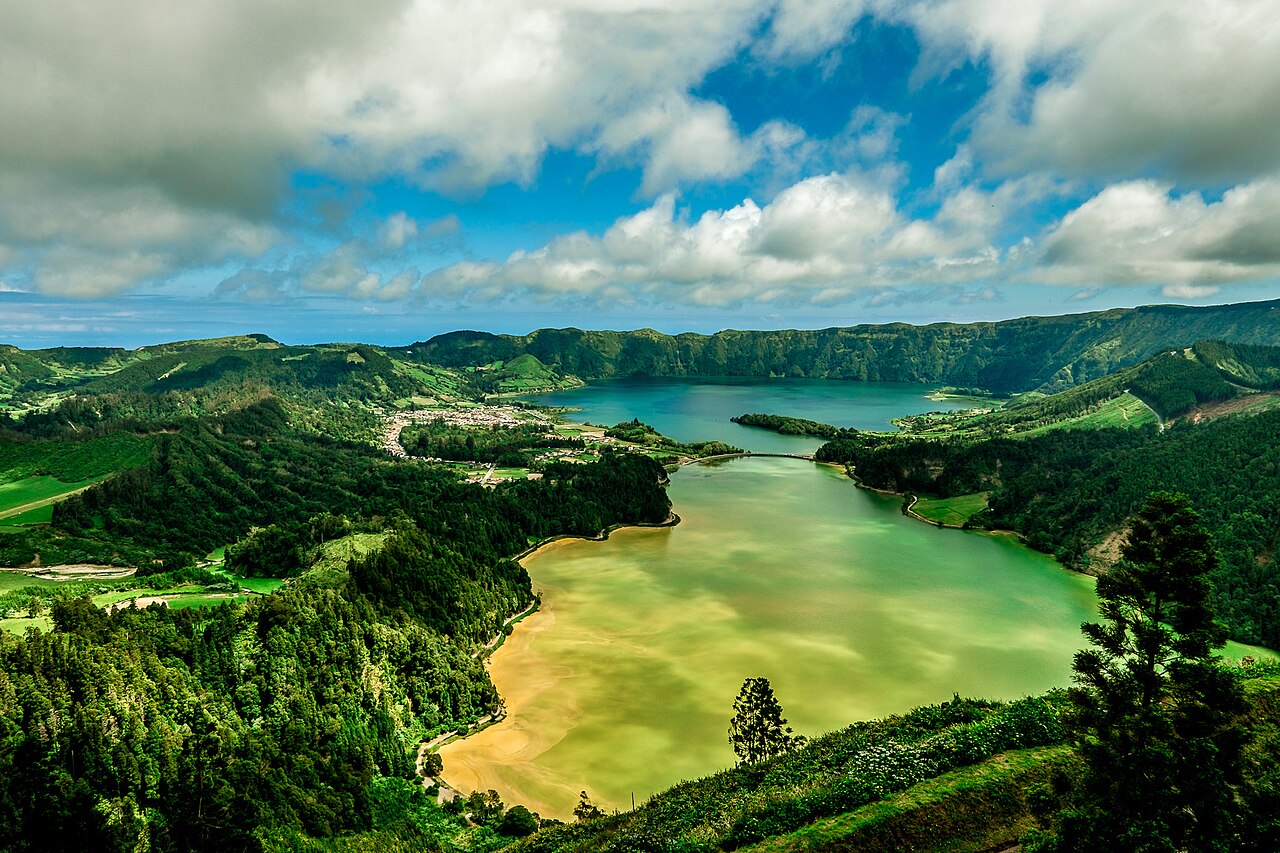
São Miguel is not just the largest of the Azorean islands — it is their beating heart. Over sixty-five kilometres of length, the island unfolds a diversity of landscapes that strikes you in the first hours: two-toned crater lakes, thermal springs steaming through tropical jungle, tea plantations unique in Europe, Atlantic waves breaking on black basalt cliffs. It is the most complete, the most varied, the island we almost always recommend for a first trip to the Azores.
At a glance
- Area: 744 km² — the largest Azores island.
- Population: around 135,000 inhabitants, half in Ponta Delgada.
- Access: João Paulo II international airport, direct flights from Lisbon (2h20), Paris, London, Frankfurt, Boston in season.
- Ideal stay: 5 to 7 full days to explore the island in depth.
- Must-see: Sete Cidades, Furnas, Lagoa do Fogo, Gorreana plantations, Nordeste, Mosteiros.
An island shaped by fire and ocean
São Miguel rose from the seabed seven million years ago, lifted by successive eruptions that welded three distinct volcanic massifs. This geology explains the landscape variety: to the west, the Sete Cidades caldera, five kilometres wide, cradles two lakes of opposing hues — one cobalt blue, the other emerald green. In the centre, the Lagoa do Fogo rests in a more intimate crater, reached after a short walk that opens onto a turquoise mirror at the heart of a juniper forest. To the east, the Furnas caldera still stirs, crossed by hissing fumaroles and hot springs that murmur underfoot.
The coastlines tell a different story: cliffs sculpted by the Atlantic, basalt islets like those of Mosteiros that rise from the water at day’s end, black sand beaches at Ribeira Grande and Ribeira Quente, natural pools carved into lava. Everywhere the vegetation speaks of the mild subtropical oceanic climate: hydrangeas edging roads, tree ferns, century-old camellias, pineapples grown under glass (a local exclusivity), and Europe’s only active tea plantations, a legacy of the 1880s.
Signature experiences on São Miguel
Hiking around Sete Cidades
The full crater loop (12 to 14 km, 4 to 5 hours) offers the archipelago’s most photographed views. The Vista do Rei belvedere and Miradouro da Boca do Inferno dominate the two lakes, while the trails sometimes dip toward the village of Sete Cidades nestled inside the caldera. For a more accessible version, the Vista do Rei → Boca do Inferno segment (7 km, 2h30) captures the essentials.
Bathing in the Furnas hot springs
The Terra Nostra pool, with its rust-coloured iron-rich waters at 38°C surrounded by a century-old botanical park, is one of the Azores’ most evocative spots. The Poça da Dona Beija, more intimate, stays open until 10 pm — the pleasure of a night bath under the stars, in the warm mist of the springs, is a moment unlike any other.
Tasting the Furnas cozido
Buried for six to seven hours in the geothermal heat of the soil, this traditional dish blends meats (beef, pork, chorizo, chicken) and vegetables in a pot sealed underground. Watching the cast-iron pots being unearthed by local restaurateurs, early in the morning at the Caldeiras, is a raw and moving ritual.
Whale and dolphin watching
Sea trips from Ponta Delgada allow encounters with sperm whales (year-round residents) and migrating great rorquals (April to June), alongside a variety of dolphins. Sighting rates exceed 90% thanks to the network of land vigias inherited from the former whaling tradition.
Visiting the Gorreana tea plantations
Founded in 1883, Gorreana grows tea on the island’s northern slopes. The visit is free and green, black and Orange Pekoe teas can be tasted on the veranda facing the ocean. A few kilometres away, Porto Formoso offers a more confidential experience.
Where to stay on São Miguel
The choice depends on the rhythm you seek. Ponta Delgada suits travellers after an urban base with restaurants, museums and nightlife — the Azor Hotel, the Octant Ponta Delgada or guesthouses in the historic centre offer a good balance. Furnas is the most atmospheric option: the Terra Nostra Garden Hotel gives direct access to the iron-rich pool, the Octant Furnas plays the contemporary upscale card, and several rural quintas welcome guests near the lake. For a full nature immersion, Nordeste, Ribeira Grande or inland farms guarantee quiet and trail proximity.
Best time to visit
May to September offers the finest balance: mild temperatures (18 to 25°C), warmest sea (around 22°C in August), reasonable crowds outside July-August. April, May and June are the prime months for hydrangea bloom and the passage of great rorquals. Winter remains visitable, wetter and windier, with the bonus of softer rates and complete tranquillity — the winter light on the island’s deep greens has something singular.
How to get there and around
João Paulo II airport (Ponta Delgada) welcomes direct flights from Lisbon, Porto, Madrid, Paris, London, Frankfurt, Amsterdam and Boston in season. TAP Portugal and Azores Airlines (SATA) operate most routes. On site, a rental car is essential for genuine exploration: the island is vast, roads wind, and public transport is limited. Count €35 to €50 per day for a small car, to be booked in advance during high season.
Frequently asked questions
How many days should I plan for São Miguel?
Five full days are the minimum for an unhurried discovery. A full week lets you enjoy Furnas without rushing, dedicate a day to Nordeste and include a sea trip. Beyond ten days on São Miguel alone, the pace becomes contemplative — ideal for those seeking disconnection.
Is the island family-friendly?
Perfectly. Thermal baths, whale watching by catamaran, tea plantations, black sand beaches, mini-hikes and educational farms form a varied programme. Medical infrastructure is solid and no specific vaccinations are required.
Can you visit São Miguel without a car?
Technically possible via guided excursions from Ponta Delgada, but the experience loses spontaneity. A rental car remains the best option. Private drivers can also be booked by the day for travellers who prefer not to drive.
Related articles & offers
- Sete Cidades hike: the complete guide
- Furnas hot springs: the complete guide
- Our tailor-made Azores trip offers
- Our private guided tours
- Our agency, Azores travel specialists
Location
Extending your trip to the mainland? Many visitors combine São Miguel with a stay in Lisbon or Porto. Our partner agencies: Secret Lisbon and Secret Porto.