
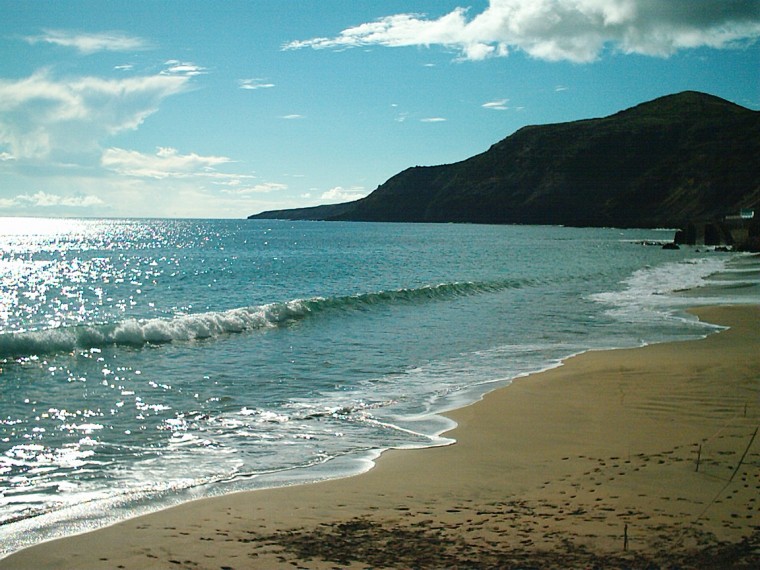
Santa Maria is the discreet one, the oldest, and the sunniest. The first island reached by Portuguese navigators in the 15th century, it keeps an atmosphere unlike any other in the archipelago: white houses topped with uniquely cylindrical chimneys, ochre cliffs that break from the usual green, and a few beaches of golden sand — a rarity in the Azores, where shorelines are almost always black. Santa Maria is not the most visited island, and that is precisely what makes it so precious for travellers seeking the quiet of a journey between ocean, soil and silence.
Santa Maria’s beaches in short: Santa Maria has the only true golden-sand beaches in the Azores. The flagship is Praia Formosa, a long blond-sand beach with sheltered, turquoise swimming — at its best from July to August. The Baía de São Lourenço adds a crescent of sand framed by vineyard terraces, and coves like Anjos offer lava-pool bathing. As the sunniest and driest island of the archipelago, Santa Maria is the go-to for a genuine beach stay in the Azores.
At a glance
- Area: 97 km².
- Population: around 5,400 inhabitants.
- Access: Santa Maria airport, direct flights from Ponta Delgada (30 min) via SATA Azores Airlines.
- Ideal stay: 2 to 3 days for the essentials, 4 days for a complete discovery.
- Must-see: Baía de São Lourenço, Praia Formosa, Anjos, Barreiro da Faneca.
A geology and climate apart
Santa Maria is the archipelago’s only sedimentary island: its yellow and ochre formations bear witness to an underwater past far older than the rest of the Azores. Marine fossils can be found above one hundred metres in altitude, remnants from when the island lay submerged. Volcanically dormant for millions of years, Santa Maria presents a gentler relief than its neighbours and enjoys the driest, sunniest climate of the archipelago — a blessing for travellers combining cultural discovery with a real beach.
Signature experiences on Santa Maria
Admire the Baía de São Lourenço
This crescent-shaped bay, framed by vineyard terraces cascading down to the ocean, is one of the most beautiful views in the whole archipelago. The fishing village nestled at its base, the vineyards encircled by basalt walls, the beach of sand blended with volcanic rock: the whole scene invites hours of contemplation from the belvedere above.
Swim at Praia Formosa
The most beautiful beach in the Azores — blond sand, turquoise water, sheltered swimming. Elsewhere in the archipelago, travellers settle for natural pools or black beaches; here, golden sand and gentle currents allow genuine beach pleasure, especially in July and August.
Visit the port of Anjos
The small port of Anjos marks the place where Christopher Columbus stopped in 1493 on his return from his first American voyage. The church and the belvedere above tell the story, and the natural pool carved into the lava rounds out the visit.
Explore the Barreiro da Faneca desert
A red-clay landscape eroded to a near-lunar quality, reached by a short marked trail. The contrast with the typical Azorean greens is striking.
Where to stay on Santa Maria
Vila do Porto, the capital, concentrates most of the accommodation offering. Hotel Colombo and a few guesthouses allow a simple, comfortable stay. The most beautiful lodgings remain the rural quintas inland, where guests sleep in traditional stone houses, sometimes surrounded by vineyards or overlooking the Baía de São Lourenço.
Best time to visit
May to September, to enjoy the driest climate of the Azores and beach swimming. July and August are especially recommended for travellers seeking a true beach. Winter stays much milder than elsewhere in the archipelago — an interesting option for an off-season stay without heavy rain.
How to get there and around
The island can only be reached by plane from Ponta Delgada (30 minutes, several daily rotations in season). A rental car is nearly essential: distances are short but public transport non-existent. Count one hour to cross the island from west to east.
Frequently asked questions
Does Santa Maria have sandy beaches?
Yes — Santa Maria is the only Azores island with real golden-sand beaches. Praia Formosa is the largest, with blond sand and sheltered turquoise swimming. Most other islands have black-sand beaches or natural lava pools, which makes Santa Maria unique in the archipelago for a beach holiday.
Is Santa Maria worth the detour from São Miguel?
Yes, for travellers planning at least 10 days in the Azores and seeking a different, more rural and drier atmosphere. Two to three nights are enough.
Can you hike on Santa Maria?
Yes, several marked trails cross the island: the Baía de São Lourenço coastal loop, the Pico Alto trail (highest point at 587 m), the windmill loop. Less elevation than elsewhere, more accessible.
Related articles & offers
- Which Azores island to choose?
- São Miguel: the complete island guide
- Our tailor-made offers
- Our accommodation and transport
- Our agency, Azores travel specialists
- Our private guided tours in the Azores
Location
Combining your Azores trip with mainland Portugal? Most flights transit through Lisbon — the perfect excuse to add a few days on the continent. Our partner agencies: Secret Lisbon, Secret Porto and Secret Portugal.