
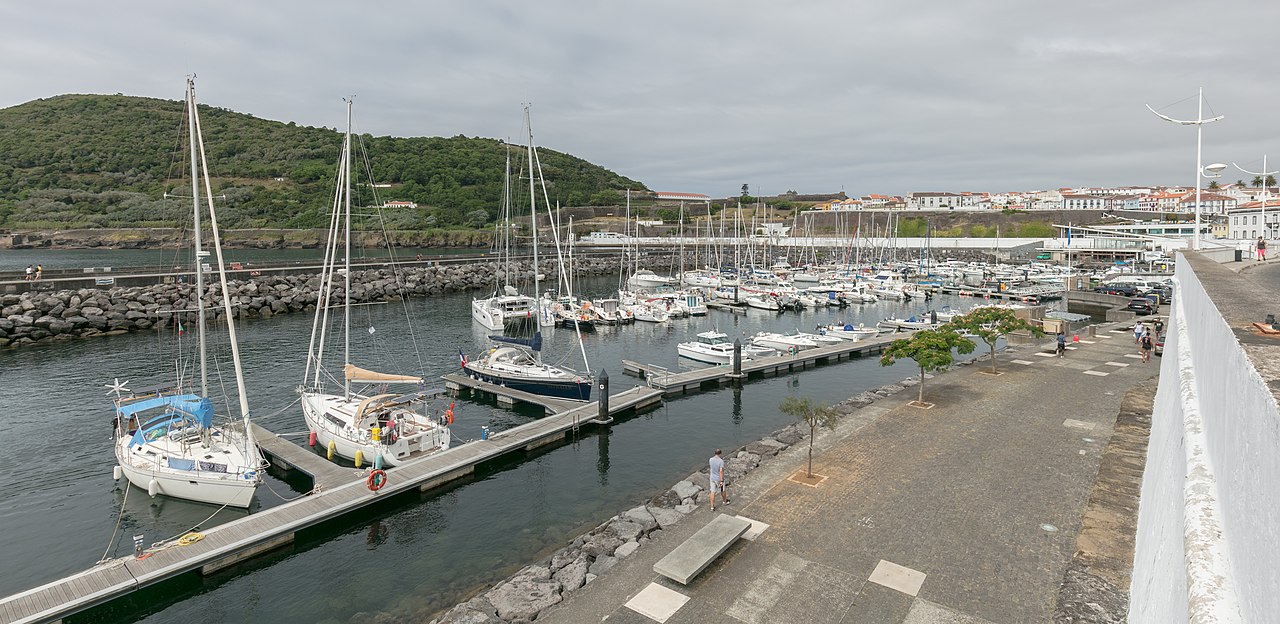
Terceira is the island where the history of Atlantic Portugal is read in the open air. Once an essential stop for ships linking the New World to Europe, it now hosts Angra do Heroísmo, a UNESCO World Heritage capital where pastel houses and paved squares tell five centuries of maritime history. But Terceira is not just stones: it is also an island of fire, luminous caves, natural pools and some of the liveliest popular festivals in Portugal.
At a glance
- Area: 400 km² — the 3rd largest Azores island.
- Population: around 53,000 inhabitants.
- Access: Lajes airport, direct flights from Lisbon (2h30), Porto, Boston in season.
- Ideal stay: 3 to 4 days.
- Must-see: Angra do Heroísmo, Algar do Carvão, Biscoitos, Serra do Cume, Sanjoaninas (June).
An island shaped by history as much as volcanoes
The third island discovered in the 15th century — hence its name — Terceira holds a unique place in Portuguese memory: key waypoint on the Indies route, royal stronghold during the succession crisis, provisional seat of the kingdom during the Napoleonic wars. All this reads in Angra, whose historic centre stands intact, with its massive cathedral, the Palace of the Captains General, checkerboard streets and fortifications overlooking the bay. Beyond, the island unfolds a gentle relief, crisscrossed by dry stone walls that draw a characteristic green patchwork across the hills.
Signature experiences on Terceira
Walk through Angra do Heroísmo
UNESCO-listed since 1983, Angra is discovered on foot: Praça Velha and its town hall, Santíssimo Salvador cathedral, Misericórdia church, Duque da Terceira Garden, and the São João Baptista fortress that protected the bay from pirates. Climb Monte Brasil at sunset to embrace the whole city in one glance.
Descend into the Algar do Carvão
A former volcanic chimney 90 metres deep, converted into a visitable cavern. A staircase leads down to an underground lake surrounded by silica-coated walls that shimmer under spotlights. Unique in Europe.
Bathe in the Biscoitos pools
On the north coast, natural pools carved into black lava offer sheltered, spectacular swimming. Steps away, the Biscoitos vineyard produces a white wine in basalt currais echoing those of Pico, to visit with tasting.
Climb the Serra do Cume
The island’s highest point at 545 m, this belvedere embraces a patchwork of meadows as far as the eye can see, drawn by stone walls. Often cited as “the most beautiful view in the Azores.” Ideal at dawn or late afternoon.
Experience the Sanjoaninas (June)
Ten days of parades, music, street bullfighting (tourada à corda), decorated impérios and popular banquets. One of the most intense festivals in Portugal. Impossible to attend without being swept up by the local energy.
Where to stay on Terceira
Angra do Heroísmo remains the ideal base: Terceira Mar Hotel offers an unobstructed view of Monte Brasil, Angra Marina Hotel occupies a central position, and several guesthouses in the historic centre allow full immersion in the city. For more tranquillity, rural quintas in Biscoitos, Angra Velha or near the Serra do Cume offer another perspective on the island.
Best time to visit
May to October overall. June for the Sanjoaninas — incomparable atmosphere but pricier, saturated accommodation. September and October offer an excellent balance: still-warm sea, moderate rain, golden light on the hills. Winter remains mild but windy, suited for travellers wanting to visit Angra without crowds.
How to get there and around
Lajes airport, served by TAP and SATA from Lisbon (2h30) and Porto, with some seasonal flights from the US (Boston). Rental car essential to explore the island in depth: €30 to €45 per day, four main agencies at the airport.
Frequently asked questions
Terceira or São Miguel for a first trip?
São Miguel for landscape variety, Terceira for cultural heritage and festivals. For a short 3-4 day stay, Terceira offers excellent intensity; for 5 days or more, São Miguel remains more complete. The ideal: combine both over a week.
Can you safely attend the tourada à corda?
Yes, secured areas are provided for spectators. The tradition is alive but controlled: the bull, held by a long rope, can only move within a limited perimeter. An impressive event, more spectacular than unsettling.
Is Algar do Carvão suitable for children?
Yes, from 6-7 years old for walking children. The staircase is solid but descends deep; bring a jacket as the ambient temperature stays around 14°C year-round.
Related articles & offers
- São Miguel vs Terceira: which island to choose?
- Our tailor-made offers
- Our cultural and gastronomic tours
- Our agency, Azores travel specialists
- Our private guided tours in the Azores
Location
Combining Terceira with mainland Portugal? Lajes airport has direct connections to Lisbon. Our partner agencies offer bespoke experiences in Lisbon and Porto.