
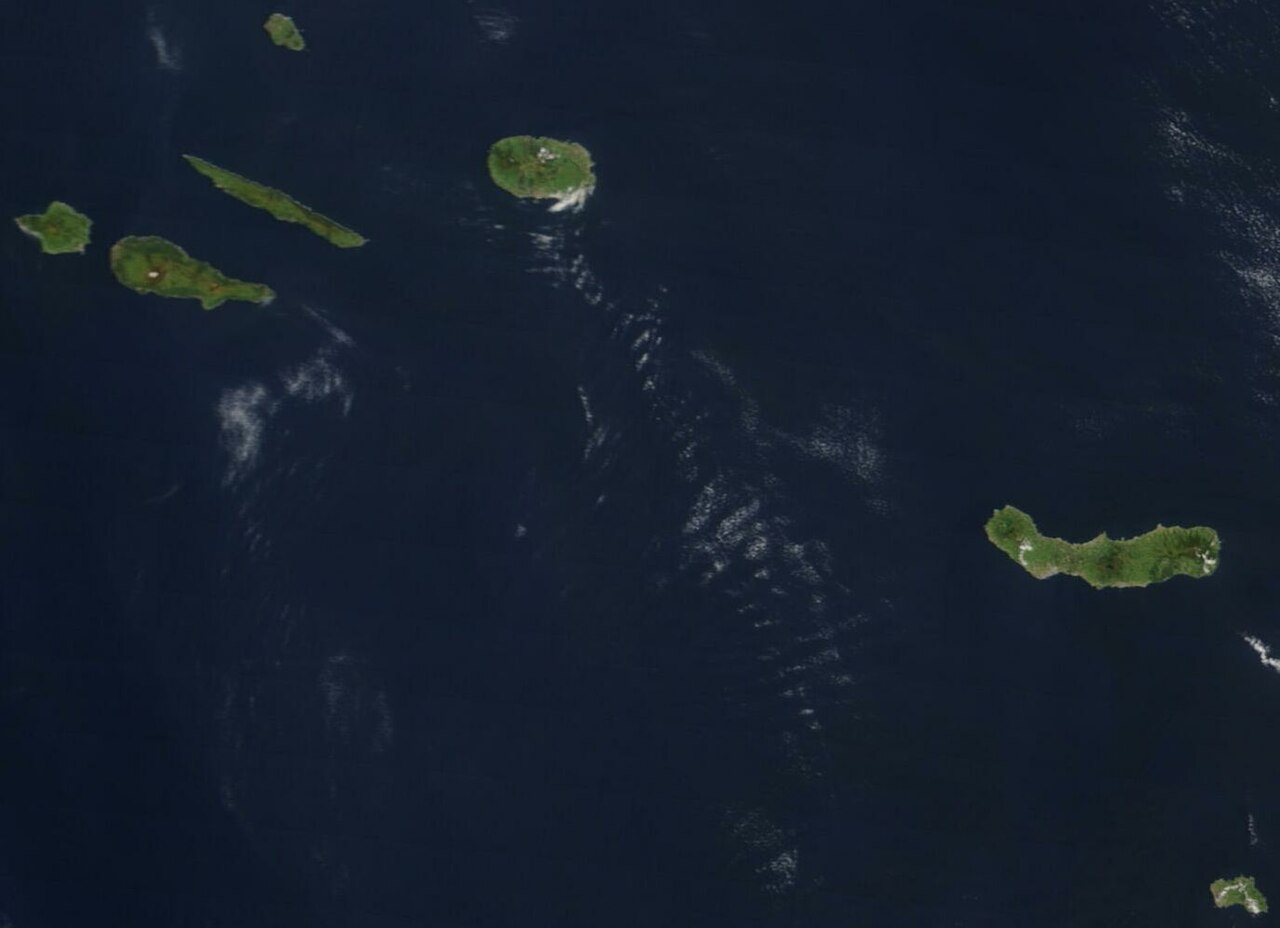
Graciosa, “the graceful one,” lives up to its name. It is the calmest of the central group, the most rural, the least visited — and certainly the most peaceful. Designated a UNESCO Biosphere Reserve in 2007, it unfolds a gentle relief punctuated by Dutch-style windmills recalling the influence of 15th-century Flemish settlers, whitewashed villages, and a volcanic caldera you descend on foot to an underground cave with crystal-clear waters. Graciosa gives itself to patient travellers, those who know how to slow down.
At a glance
- Area: 61 km² — the smallest of the central islands.
- Population: around 4,200 inhabitants.
- Access: Santa Cruz airport, SATA flights from Terceira (25 min) or São Miguel (45 min).
- Ideal stay: 2 to 3 days.
- Must-see: Furna do Enxofre, Santa Cruz, Carapacho, Praia, windmills.
Between Biosphere Reserve and living traditions
Graciosa was settled from 1450 onward, partly by Flemish merchants drawn by the pastel trade, a valuable dye plant at the time. Their mark lingers in the Dutch-style windmills scattered across the island — about twenty remain, restored or in ruins, giving Graciosa its singular silhouette. The gentle relief, the dry and windy climate, the white stone of the buildings: everything conspires toward an identity of its own, almost Mediterranean, in the heart of the Atlantic.
Signature experiences on Graciosa
Descend into the Furna do Enxofre
At the bottom of the volcanic caldera, a 194-metre cave holds a cold-water lake and a sulfur mud spring. A staircase of 184 steps descends into this underground world — one of Europe’s most remarkable. Guided visit of about 45 minutes, open in season.
Visit Santa Cruz and its white streets
The island capital is a delight to walk: paved squares, the matrix church, white houses with colourful doors, and the small fishing port. The Whaling Museum tells the island’s whaling history with remarkable educational quality.
Relax at the Carapacho thermal baths
On the south coast, a thermal complex draws directly from underground waters to feed warm saline pools. Relaxation atmosphere, modest but authentic spa, with swimming possible in the adjacent natural pools carved into the lava.
Discover the vines and local white wine
As on Pico, Graciosa’s vines grow in black basalt currais sheltered from the wind. Production remains artisanal but of quality. A few cellars open by appointment offer tastings.
Where to stay on Graciosa
The offering remains modest but quality: a few guesthouses in Santa Cruz, rural quintas inland, and Graciosa Resort on the coast. The most atmospheric stay remains the restored windmills, rare but unique.
Best time to visit
May to October. July and August for a mild sea and long days. The Holy Spirit festivals in June-July add a local, popular dimension.
How to get there and around
Only by plane from Terceira (25 min) or São Miguel (45 min). Rental car needed to explore the island; distances are short (18 km long) but public transport non-existent.
Frequently asked questions
Is Graciosa worth a short detour?
For travellers planning at least 10 days in the Azores and fond of quiet islands, yes. 2 nights are enough to grasp the essentials. For a short first trip, prefer São Miguel or Terceira.
Is the Furna do Enxofre cave suitable for children?
From 7-8 years old with walking children. The 184 steps can be tiring on the way up. Bring a jacket, inner temperature stays cool.
Related articles & offers
- Which Azores island to choose?
- Our tailor-made offers
- Our activities
- Our agency, Azores travel specialists
- Our private guided tours in the Azores
Location
Combining your Azores trip with mainland Portugal? Most flights transit through Lisbon — the perfect excuse to add a few days on the continent. Our partner agencies: Secret Lisbon, Secret Porto and Secret Portugal.