In brief
- First-time travellers: São Miguel, the most complete island, for a representative first contact.
- Hiking and volcano: Pico, for the climb to Portugal’s highest point and the UNESCO vineyards.
- Historical heritage: Terceira, with UNESCO-listed Angra do Heroísmo.
- Rural authenticity: São Jorge and its fajãs, preserved coastal plateaus.
- Remote adventure: Flores, the most spectacular and hardest-to-reach island.
Choosing an Azores island means choosing a facet of the archipelago. Each one has its own personality, its signature landscape, its pace. São Miguel has nothing in common with Pico, which has nothing in common with Flores. This guide is not about ranking islands from best to worst — they all deserve to be seen — but about helping you identify the one that matches your traveller profile and the type of trip you are after.
A useful geographic reminder: the nine islands are organised into three groups. The eastern group (São Miguel and Santa Maria) is closest to Europe. The central group (Terceira, Graciosa, São Jorge, Pico, Faial) gathers the islands closest to each other, linked by ferries. The western group (Flores and Corvo) is the most remote, over 200 kilometres from the central group.
São Miguel: the big island we always recommend first
São Miguel, nicknamed “the green island,” is the largest and most populated (65 km long, around 135,000 inhabitants). It concentrates most of the Azores images you probably have in mind: the two-toned crater of Sete Cidades, the village of Furnas and its fumaroles, the tea plantations of Gorreana (unique in Europe), the thermal pools of Terra Nostra, sunsets over Ponta Delgada.
It is also the most versatile island: you will find demanding hikes, wellness spaces, refined gastronomy and old fishing villages. It is the best connected, with direct flights from Lisbon, Porto, Paris and other European capitals in season. For a first trip, São Miguel is rarely a wrong choice.
Pico: the volcano, the sea and the wine
Pico is dominated by its perfect cone peaking at 2,351 metres — the highest point in Portugal. The island appeals to two kinds of travellers. Hikers, who come for the ascent (8 to 10 hours round trip, demanding but accessible with a guide). And wine lovers, who explore the vineyards listed as a UNESCO World Heritage site, planted in small parcels shielded by black lava walls called “currais.”
Pico is also the best spot to watch sperm whales and dolphins, right across from Faial. The atmosphere is rural, lightly touristic, deeply maritime. Accommodation is often restored basalt stone houses. Pico is to be lived, not ticked off.
Terceira: the historic and festive island
Terceira hosts Angra do Heroísmo, a UNESCO World Heritage site since 1983. Once the Portuguese capital during the age of discoveries, the city preserves an exceptional historic centre with colourful houses and paved squares. It is the island where the history of Atlantic Portugal reads most clearly.
Terceira also has an intense festive life, with the Sanjoaninas in June, a festival of bull-running, music and popular celebrations. Varied volcanic landscapes: the glowing underworld of the Algar do Carvão caves, the verdant plains of Biscoitos and natural pools carved into the lava. Terceira suits travellers looking for a balance of culture, tradition and nature.
Faial: the sailors’ world port
Faial is a seafaring island. Its capital, Horta, shelters one of the most famous marinas in the world, a compulsory stop on the transatlantic sailing route. Every crew that anchors there paints its fresco on the quay, creating a collective tapestry of colours and names. The Peter Café Sport, a local institution, keeps the tradition of sailors’ cafés alive.
The island also offers the Cabeço Gordo caldera (2 km wide, accessible by car) and the recent volcanic zone of Capelinhos, where a 1957-58 eruption sculpted a preserved lunar landscape. Faial unfolds in 2 to 3 days and pairs perfectly with Pico, 30 minutes away by ferry.
São Jorge: the longest and most secret
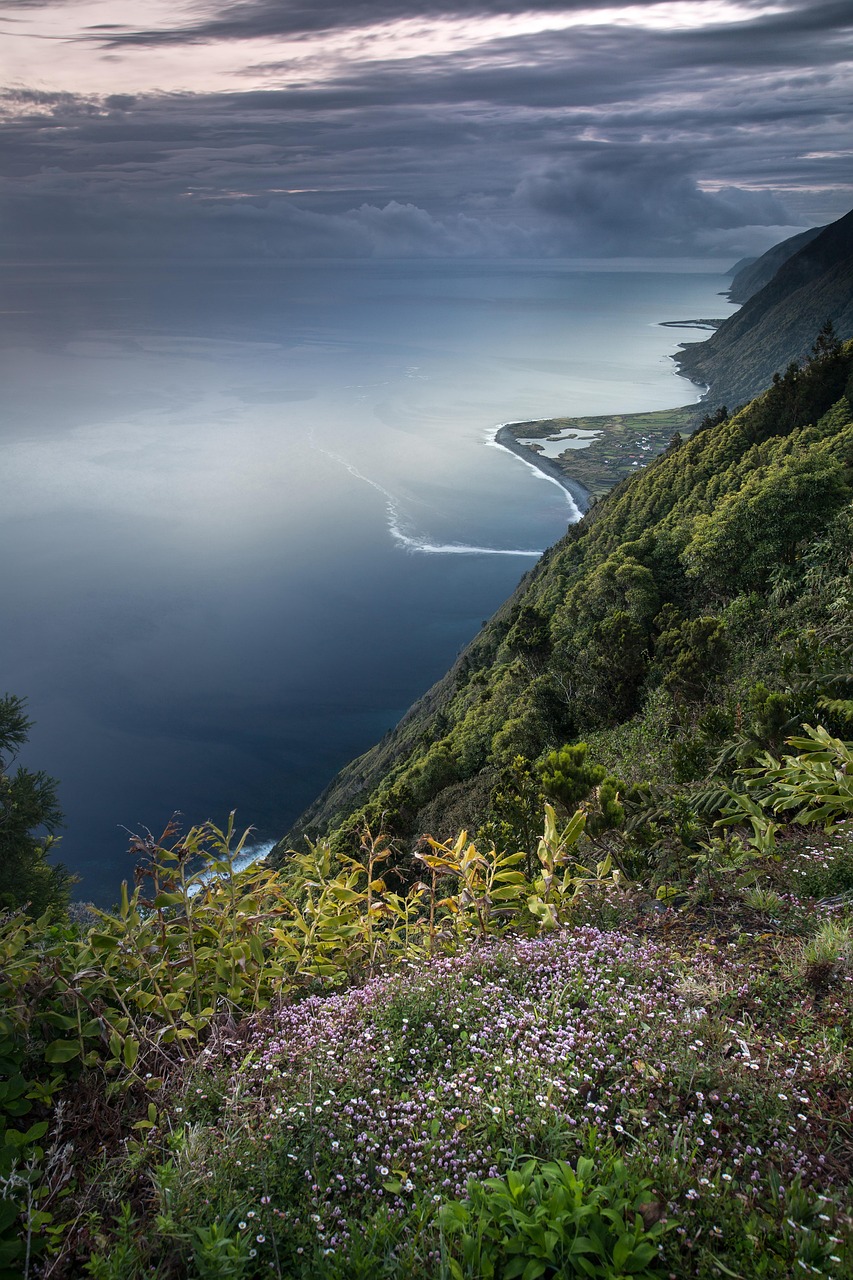
São Jorge is a narrow elongated island (54 km long, only 7 km wide), with a central ridge over 1,000 metres high. What sets it apart are the fajãs, coastal plateaus formed by lava flows or landslides, reachable only by steep trails. Each fajã is a micro-world: fishermen, subsistence crops, brackish lagoons.
São Jorge is the cheese island — the queijo de São Jorge is PDO-certified and ranks among the finest in Portugal. It is also an exceptional destination for hikers after preserved, lightly trodden trails. Not an island for a first trip, but for a well-informed return.
Flores: the most spectacular, the most remote
Flores earns its name: it is the island where flora erupts in countless shades, especially in spring. Suspended lagoons, vertiginous waterfalls (the “Sete Lagoas” of the central plateau), cliffs that plunge straight into the Atlantic — Flores is often described as the most beautiful of the Azores. It is also the hardest to reach (a single daily flight from Faial or Terceira, unpredictable weather) and the least equipped with infrastructure.
Flores is for experienced, autonomous travellers who accept that their return flight may be delayed by a day or two. Corvo, its neighbour, counts only 430 inhabitants and can be visited in a day from Flores.
The three other islands: Santa Maria, Graciosa, Corvo
Santa Maria is the southernmost and sunniest, with the only real sandy beaches of the Azores. It appeals to short stays focused on relaxation and swimming. Graciosa is the smallest of the central islands, rural and peaceful, ideal for a 2-day detour. Corvo, finally, is a caldera-island of 17 square kilometres, wild and minimalist, for travellers seeking authentic isolation.
Frequently asked questions
Which is the most beautiful Azores island?
Travellers most often cite Flores for the density of its landscapes, or São Jorge for the authenticity of its fajãs. But “most beautiful” entirely depends on what you are looking for: Pico for raw volcanism, São Miguel for variety, Terceira for heritage.
Can you visit all the Azores islands in a single trip?
Visiting all nine islands takes about three weeks and solid logistics. Most travellers choose 1 to 4 islands depending on trip length. Better to come back than stretch the trip too thin.
Which island for a relaxation-focused trip?
Santa Maria for its beaches, São Miguel for the Furnas and Terra Nostra thermal pools, Faial for the harbour atmosphere. Avoid Pico or Flores if your priority is calm contemplation without physical effort.
Can you combine several islands without wasting time?
Yes, the central group (Faial, Pico, São Jorge) combines very well thanks to fast ferries. São Miguel and Terceira require a flight. Flores and Santa Maria are more isolated and only justify long trips.